Friday, July 6, 2012

Your Weekend: Exploring the Texas Colorado River


The Texas Colorado River flows 860 miles southeast across the state of Texas to its mouth on the Gulf of Mexico, straddling 20 counties. It fills nine lakes and man-made reservoirs, providing the water for electricity and farming for many parts of Texas. A few of the lakes the Colorado River feeds into include Inks Lake, Lake Travis, Lake Austin, and Lady Bird Lake.

River of Contrasts: The Texas Colorado (Texas A&M University Press, 2012) by Margie Crisp explores the state's longest river, introducing readers to its denizens -- animal, plant, and human -- and the natural history, politics and other factors influencing the fate of the river and the water it carries.

Paired with Crisps’ stories featuring the Colorado River are pieces of her own artistry. Her photographs and maps round out the useful and beautiful accompaniments to this portrait of one of Texas's most beloved rivers.  

For this Weekends with TAMU Press Books, we asked Crisp about her inspiration for writing the book, as well as for her favorite stretch of the Texas Colorado River:
“When I started the Colorado River project, as far as I was concerned, the river began and ended in Bastrop County.  I know that sounds incredibly short-sighted but it isn't an uncommon perception of the river at all.  When I realized how little I knew about the Colorado River, I got curious. I thought that I knew something about rivers after all, but I soon learned that many of my assumptions about the river were not accurate.  The biggest surprise for me was learning that the water (what little there is) that flows down the river does not necessarily end up in the Gulf of Mexico.  Water is pulled from the river for all sorts of uses, sometimes returned, often not, and new water flows in from tributaries.
The river downstream of Austin (in Bastrop County) was, at one time, incredibly polluted by the City of Austin's sewage overflows.  But no longer.  Now the water is extraordinarily clean and the river is a remarkable place for canoers, kayakers, and fishermen.  From east Austin through Bastrop County, there are numerous public boat ramps as well as outfitters that can supply paddlers with boats and gear.  I'm always surprised that there are so few people who paddle the Colorado, below Austin.  Of course, it is "my section" of the river but the slow current, abundant fish and birds, and clear water make this section of the river a hidden jewel.”

Location:Lost Pines and Red Bluff below Bastrop

Getting There: From College Station, take HWY 21 West towards Bastrop for 77 miles. You can enter the River several ways, one way is through Fisherman’s Park. Once on the Texas Colorado River, paddle through downtown Bastrop, past Fisherman’s Park. You will float under the highway, past Old San Antonio Road crossing, and eventually come upon the sands of the Lost Pines.

About Lost Pines: It is a varying, beautiful river landscape that includes both pine and oak trees. There are many hiking paths alongside the river as well.

What You'll See: Besides the breathtaking and serene views, Crisp has seen bald eagles, ducks, songbirds, cardinals, and numerous wildflowers. She has noted that beavers are a possibility for lucky paddlers, too.
--Madeline Loving

Thursday, July 5, 2012

Throwback Thursday: Best of the 90s

The 1990s: Oversized glasses, obnoxious sweat suits, episodes of Full House, furbies, beanie babies, VCRS...the list of fads could go on. What about the musical obsession with boy bands? Maybe your favorites include NSYNC, Backstreet Boys, or 98 Degrees. Another popular boy band was the British pop band Blur, created in the 1990s.This week Blur will be releasing their first new single in years via Twitter.

In honor of Blur and our love for the great decade of the 90s, we have compiled a staff-curatedlist of our top 5 favorite books, all originally published in the 1990s.


1.   Courthouses of Texas (Texas A&M University Press, 1993) by Mavis Kelsey and Don Dyal

Courthouses and the “squares” around many of them offer a bonanza for history buffs, antique collectors, genealogists, architecture enthusiasts, and photographers. Many of them house or are near local history museums, and many display historical markers that introduce the area to visitors. Especially in many smaller county seats, the courthouse square offers a genre scene of a special moment in Texas’ life.

2.    One Woman’s Army: A Black Officer Remembers the WAC (Texas A&M University Press, 1995) by Charity Adams Earley

Black members of the WAC had to fight the prejudices not only of males who did not want women in their "man's army," but also of those who could not accept blacks in positions of authority or responsibility, even in the segregated military. With unblinking candor, Charity Adams Earley tells of her struggles and successes as the WAC's first black officer and as commanding officer of the only organization of black women to serve overseas during World War II.

3.    Houston: The Unknown City by Marguerite Johnston.

It is a history marked by murder, mutiny, and the ironies of war, by comedy and high jinks, by heroism and a remarkable generosity. This fascinating social history grew out of Marguerite Johnston's forty years of friendship with the city and its people. It traces Houston's first families through interlinking marriages, charitable associations, and business partnerships.

“The author . . . gave me a delightful and deep insight into a city about which we continue to publish a great deal.  Because of her, I recognize the names and the drama of Houston’s unknown story in a way I could not have otherwise. It’s a great read and a great resource by a great woman.”--Mary Lenn Dixon, Texas A&M University Press editor-in-chief

 4.   Adios to the Brushlands (Texas A&M University Press, 1997) by Arturo Longoria

A trained biologist and one-time investigative reporter, Longoria brings his skills of observation and expression to sing the song of this vanishing habitat that once covered nearly four million acres of the Rio Grande Valley. In moving but understated prose he captures the wonder of the brushland and symbolically and emotionally links its loss, through rootplows and bulldozers, to the death of his grandfather, who had introduced him to that world.

“. . . a classic work of nature writing that gave voice to the South Texas landscape and the people who have watched it change irrevocably.”--Shannon Davies, Texas A&M University Press Lindsey Merrick Editor for the Natural Environment

5.   Twentieth-Century Doctor: House Calls to Space Medicine (Texas A&M University, 1999) by Mavis Kelsey

In understated but compelling prose, Kelsey brings to life this period of unparalleled challenge and growth in the pioneering Houston medical community. Through anecdotes and memories backed by careful notes he took at the time, he reminds readers of the human face of medicine.

“I gained great compassion and understanding about a gentleman who has done so much for the press. Working with Kelsey has been a privilege and an honor.”--Kevin Grossman, Texas A&M University Press Pre-press and Electronic Publishing Manager

You can still order these books from our website, http://tamupress.com.

--Madeline Loving
Wednesday, July 4, 2012

Exploding Cookie Bars


     Well it is July 4, and we are banned from fireworks due to very hot and very dry weather. But it's the Forth of July; something needs to explode!  So with our Pop Rocks experiment (Pop Rocks Science) still fresh in mind, I decided to make some exploding cookie bars!

     I started with a really yummy recipe for LoftHouse Sugar Cookie Bars I first found on Chef in Training.

Ingredients

1 1/2 C sugar
1 C butter, room temperature
8 oz cream cheese, room temperature
1 egg
2 t vanilla
2 1/2 C flour
1/2 t baking soda
1 t baking powder

Preheat oven to 350 degrees and spray a jelly roll pan with cooking spray.

Cream butter, cream cheese, and sugar. Add egg and vanilla; mix well.  With mixer on low, add flour, baking soda, and baking powder until just combined.


At this point you can press it in your pan and bake for about 20 minutes. Or you can add Pop Rocks and then bake it. The Pop Rocks crackles when you add them, but they do keep a little of their pop.  I do think you would need more then I added (2 envelopes) to notice them in the cookie.


A sleepy Nadia got up in time to get the beater. (I know, beater for breakfast = bad parenting. If it makes it better she had some cereal afterwards.)


     For the icing, I used vanilla buttercream from Cookies & Cups because it is Nathan's favorite.

Ingredients

1 1/2 C salted butter, room temperature
1/2 C shortening
2 lb powdered sugar, sifted
1/2 C milk

Cream butter and shortening until smooth (about 3 minutes) with paddle attachment.

Slowly add sugar, once it is all incorporated, increase your speed to medium-high and whip for 1 minute.  I didn't sift the sugar, and it still tastes good.  However, I think sifting it would improve the texture a little (there isn't much to improve).

Add milk to your desired consistency. I only needed 1/4 C; I think due to the heat in my kitchen.


We colored out icing blue and topped it with more of the secret ingredient,  Pop Rocks!  White cookie, blue icing, red Pop Rocks= patriotic exploding dessert!  I used 3 envelopes, and you really notice them on top. I have a spare envelope just in case some of the pop runs out.


Of course the girls liked them, but when Nathan tried them he said, "That is so cool (the popping)." Glad I made a cool dessert.

     I have to add, don't add the Pop Rocks on top until you are ready to serve them because they don't lose their "pop" over time.  Also after you have added them, keeping them cool helps maintain the "pop" as long as possible. Enjoy!

Eli's Monkey Party

      Well my baby isn't really a baby anymore! He turned one and had the first of his first birthday parties (we're having 2) yesterday!  This one was a small party mainly for Eli's Grandma and Grandpa who had to leave town today; of course we had a few others too. Before Eli was born I called him my monkey, so it was fitting to have a monkey theme.


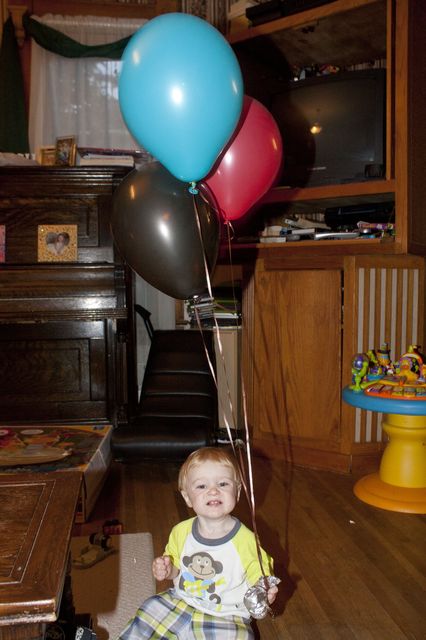
     Before the party even started Eli was super excited.  Mainly because I had some balloons blown up! Carrying them in the house he kept pointing and saying, "ba, ba..."  He loved them!  Unfortunately it doesn't look like there will be many balloons in the future due to the helium shortage. The florist here said that would probably be the last tank they could get!


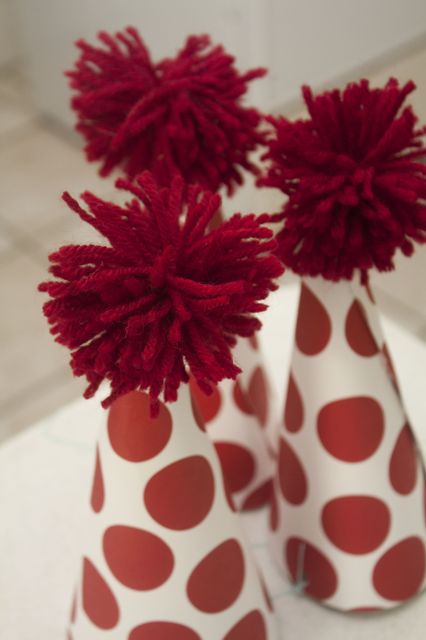
     I had cute little hats made for Eli and the girls, and although the girls were excited about them in the morning, they wouldn't wear them at party time.  I did get a couple pictures of them on, but they came off immediately!


     He didn't eat a whole lot of dinner even though it was pizza (which he loves). I think he was too preoccupied with trying to tear the ribbon banner off his booster seat.


     At first Eli was very interesting in presents. However, as soon as Ryan and Wendy showed up he was more interested in watching them. He got back into his presents though!


Acting like a good again!

Grandpa told Eli this was a CAT toy, and Nadia replied, "No, it is a backhoe!"


He looked around after tearing the paper to make sure he wasn't going to be in trouble.


     The cake was the big thing of the evening for Eli; he loved it! Or he at least loved the icing!  It was carrot cake and cream cheese icing just like the girls had on their first birthdays.  I didn't think to take it out of the fridge early though, so it was a little cold and hard to get started. Eli figured it out though! After trying to lick it a few times, he dug in with his fingers. Then he went back to trying to shove his face into it!  We eventually gave him a fork, and he dug in with that too even though he missed his mouth a couple times.


     I was really surprised at how clean he was. With the way he eats normal meals I was expecting a repeat of Nadia with cake rubbed in his hair and all the way down to his toes!  Other then the red icing, he really wasn't too hard to clean up.  I think overall he had a pretty fun first birthday!  

Ready for bed, but I don't want to leave my balloons!

Eli's second first birthday party: Eli's Little Man Party


Tuesday, July 3, 2012

Corpus Christi Sands Site of Historic U.S./Mexican Standoff

Next time you're setting out your beach towel or carefully crafting a sand castle on Corpus Christi Beach, consider this: U.S. soldiers once lay in wait for seven months for Mexican forces here.

In 1845 the American Army under the command of General Zachary Taylor encamped on the shoreline of Corpus Christi Bay. From the Mexican viewpoint, the camp was actually inside Mexico. A long-standing dispute between Mexico and the now defunct Republic of Texas about the boundary line separating the two had become an issue with the United States.

Intending to prove that his national domain extended to the Rio Grande by virtue of the annexation of Texas, President Polk ordered Taylor to march 160 miles south to the river. When the army reached the site of present-day Brownsville, Taylor ordered troops to build a fort directly across the Rio Grande from the Mexican village of Matamoros.

A temporary American army camp on the beaches of Corpus Christi Bay was one thing, but a small but permanent fort built on what the Mexicans believed to be their turf was something else. The gauntlet had been thrown down by the invading U.S. forces.

The challenge was quickly answered when on April 25, 1846, a Mexican force of some 1,600 men ambushed a US cavalry patrol, resulting in over 60 American casualties.

Over a century and a half later, the bay is still there, of course, but everything else has changed from its days of military importance, say historians Thomas Alexander and Dan Utley, co-authors of Faded Glory: A Century of Forgotten Texas Military Sites, Then and Now (TAMU Press, 2012).
In the book, the co-authors embark on a journey to uncover 29 forgotten historical sites in Texas, including Corpus Christi Beach.
"A beautiful bay front, featuring towering skyscrapers has replaced the 1845 city of cotton canvas tents," the authors write. "The original beach is covered by a seawall and a manicured sweep of handsome boulevard. No vestige of Taylor's camp managed to survive the decades of necessary improvements that have elevated the terrain where the many tents of his army once swayed in the Gulf's sea breeze."
A cemetery several city blocks inland from the shore contains the graves of sailors killed in a ship’s boiler explosion that occurred on the bay during the time of the encampment on the beach. A marker in nearby Artesian Park indicates a possible site of Taylor’s personal tent, while other accounts suggest the general actually spent his spare time by the bay at a location one and a half mile to the north.

It is possible to stand atop the seawall that spans the bay front and look to the south along the curve of the shoreline to get at least a fleeting sense of the magnitude and sweep of Taylor’s encampment. On the far horizon, some five miles distant, a thin peninsula juts out into the bay. That same landmark is clearly visible in the lithograph made in 1845 when the army’s tents filled nearly every square foot of the beach that has now disappeared beneath a seawall.


Author Tom Alexander gives us his favorite historic site from Faded Glory:

"My favorite site as discussed in Faded Glory is probably Glenn Spring, located deep in the Big Bend National Park.  Once a bustling war factory and army outpost, it is also the site of the last known military invasion of the United States.  Today, it is nothing more than a hard to find pile of rocks."

Look for Faded Glory this fall for more on Texas's forgotten military sites.
--Madeline Loving