Tuesday, January 3, 2012

Skype on Steroids

Skype. Many of us have heard of it and maybe even tried it once or twice with a computer and webcam or our smart phone. Seeing the faces of those you are communicating with can make a world of difference in a conversation. Subtle communication strategies like facial expressions and body language help make conversation more meaningful. Without them, it is easy to misinterpret another’s intent. These strategies are just as important while learning.

Videoconferencing is like Skype on steroids. Often, the video connection is as clear as if you were standing in the same room as the person you are talking to in the crisp HD quality we have come to expect with technology.


I have to be honest, at first when I was given the responsibility to lead the videoconferencing program for the International Wolf Center I was a bit skeptical about the method. The heart of what I was taught in teaching was that the best experience for kids is when they go to a place and experience it. To me this meant hands-on learning outside. Watching a bobbing head on a television screen inside a classroom was boring and didn’t even compete with a movie. How would this be engaging life-changing learning for kids?

Fast forward a few months. Groups were signing up for programs from states like Wisconsin, Indiana, Pennsylvania, Michigan and New York. These participants couldn’t afford to visit the International Wolf Center in Ely, MN with their limited budgets. However, they still wanted the experience of learning about and seeing wolves. Through observing students in programs I was able to see first-hand how fun videoconferencing could be. Participants were playing games, plotting out wolf locations from real radio collared wolves living in or near their area, acting out skits, touching props like wolf pelts and deer antlers, having controversial discussions about their opinions on management, using art to express their learning and asking questions to a wolf expert. Participants were actually engaged, making connections and learning things!


As a classroom teacher by trade, I know how little time, money and resources educators have to prepare lessons. These videoconferencing programs are less expensive than a field trip, easy to register for online, taught by another teacher, include all the preparation materials and extensions for pre and post-activities. It seems like a no-brainer, right? Three years later, I am still convinced that videoconferencing programs are an effective strategy that should be utilized by teachers across the globe.

Here at the Center, I am able to offer this engaging technology to a wide variety of audiences. Our videoconferencing programs are available to schools, colleges or universities, nature centers, zoos, nursing homes, home-school groups, hospitals, libraries or any location with videoconferencing equipment.

Our content meets state and national standards in lively presentations that are developmentally appropriate and interactive. We also employ other capabilities such as cameras with a live feed for observation of our ambassador wolves “in action” in their naturalized habitat and a document camera to view real artifacts like pelts, skulls and scat make videoconferencing leaps and bounds above the rest.

Through a grant from the Minnesota Environment and Natural Resources Trust Fund we are able to offer FREE videoconferencing programs to schools in Minnesota through 2013. Participants receive one program of their choice and a Wolf Loan Box rental (2 weeks) with their registration. Programs paid for through the grant are filled on a first-come, first-served basis. These programs are available to groups outside of Minnesota as well.

How do I sign up?

Don’t have the equipment? Check with your local university, library or government center to see if you can use their equipment. Many offer this service free or for a reduced fee. You may also contact Technology Information Education Services (TIES)or Video Guidance about rental equipment options in Minnesota.

If you are curious about incorporating other forms of technology the International Wolf Center has to offer, check out some of these resources:
• Wolf Cams
• Wolf Logs
• Wolf Video
• Podcasts
• Online Curriculum
• Gray Wolves, Gray Matter Curriculum (free PDF)
• Track wolves like a biologist

Be sure to keep your eyes peeled for ways to utilize these tools in posts to come. Happy New Year!


Tuesday, December 27, 2011

Success!


This is the final installment of a three part series, which details the efforts to retrieve a radio-collared wolf that died in the fall of 2010.  The first four attempts were covered in the most recent blog posts.


On Foot
At some point this story has to end, right?  After our attempts in February, to find wolf 989 we had decided to let the wolf stay where it was.  But then March came to the Ely area, and with it spectacular weather and melting snow.

I decided to give it one more try. On Saturday, March 26, I set out with two friends on a spectacular day.  Brilliant blue skies, warm sun and no snow on the lakes made for fast going.  The winter had been cold and long, and although the temperatures on this day would reach the mid-30’s, there was still nearly three feet of ice on the lakes on which we traveled.

We hiked out to the location between Bald Eagle and Turtle Lakes an hour faster than we had been able to ski the same 6 mile distance.  Between faster travel and longer days, time would not be a limiting factor on this trip.


We walked right up to the wolf’s location and were getting strong signals with the radio telemetry unit.  We checked the high area, we checked the low area and we even climbed down to a rock ledge and into a large crack that feasibly could hold a wolf.

There were signs of other animals in the area this time and speculation flew around about what might have happened to the wolf’s body.  We shoveled significant amounts of snow to be certain we weren’t missing anything.  No luck.  After about an hour and a half of looking, we decided that the wolf—or possibly just the collar—was buried in the snow and ice.


By Canoe
Feeling a bit like Captain Ahab at this point, I wanted just one more look after the ice went out on the lakes and the snow melted.  My wife, Molly, and I connected with students from Outward Bound who needed to complete a service project to successfully finish their course.

They agreed to paddle with us and help us look for the wolf.  It was a wonderful day for a paddle and the students, teenagers from all over the United States, were a joy to paddle with.  Unfortunately, the outcome was the same.  The signal was still strong and it appeared to be at the base of the cliff.  Despite much crawling around and checking in very small spaces we could not locate the wolf.

Wolf 989 would remain where he died. Or so I thought.


Success!
In early October I received an e-mail from Dr. Shannon Barber-Meyer, the wolf biologist with the USGS wolf-deer study.  The subject of the e-mail was “Wolf 989’s story ends.”  Two field technicians for the project made a final attempt and found the wolf.

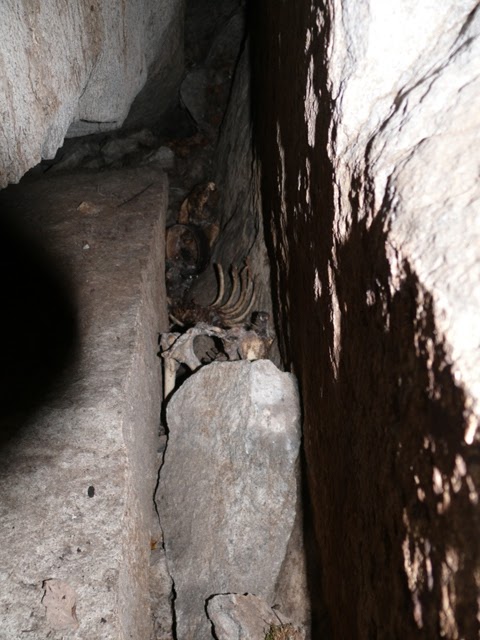
It was located in the large crack that we had looked around and into numerous times, but was all the way at the bottom.  During the winter it had been covered in snow.  One of the technicians, Hans Martin, climbed all the way down into the crack—an extremely tight space—and brought wolf 989 out for inspection. (See pictures).  The technicians also found part of the shoulder and some tufts of hair up on the ledge above the crack.  They then took measurements, brought the skull back for inclusion in on-going research.  They brought the collar back as well, to put it back in use in the future.                     (Photo: Hans Martin)


Now the question became, “How did the wolf get there?”  Though we will never know the answer, a number of theories were discussed and debated. Did it die above the crack and then slide down into it with the snow?  Was it chasing prey and slip unintentionally into the crack, leaving it unable to get out?  Did it die up on the ledge and get carried down into the crack by a scavenger?  Each one of those possibilities has supporting and contradictory evidence.

What did I Learn?
Being an educator, I immediately began to think about the lessons learned from this effort.  To be sure, I gained experience in winter travel by ski and by dog team.  I learned a little more about the use of radio telemetry equipment in the field and I got the chance to travel with some excellent people in a variety of conditions.

I also learned that any preconceived notions of the romance and glamour of the life of a field biologist might need to be adjusted to meet reality.  Harsh weather conditions, challenging physical efforts and the disappointment associated with not achieving the task at hand are just some of the many obstacles they face.  I’ll definitely offer to assist in retrieval efforts in the future hope to be able to share some of those experiences in this space as well.

Tuesday, December 20, 2011

TAMU Press author, Brandon Rottinghaus comments on Perry’s Ad

Governor Perry's latest ad, entitled "Strong," attracted roughly 750,000 views on YouTube in two days.

Brandon Rottinghaus, author of The Provisional Pulpit: Modern Presidential Leadership of Public Opinion (TAMU 2010) and Associate Professor of political science at UH commented on the controversial ad on KUHF Houston Public Radio. He says commenters who declared the ad promotes hatred and violence are more representative of the general electorate.

"His strategy right now is to ignore the general public at this stage, and focus in on the voters who are of very conservative stripe, but who are also very active. And that is going to be his strategy for trying to pry off some of the votes that have been siphoned by Newt Gingrich." — Rottinghaus

Rottinghaus also said that by hitting cultural issues so strongly, Perry has found a way to differentiate himself from the front-runners in Iowa.

Watch Perry’s ad here:


Rottinghaus’s The Provisional Pulpit: Modern Presidential Leadership of Public Opinion is for sale on the Press website and available in an edition. Read more about the book and get your own copy now!

UGH!


This is the second part of a three-part series, which details the efforts to retrieve a radio-collared wolf that died in the fall of 2010.  The first attempt is covered in the most recent blog post.

Humbled after our unsuccessful attempt to retrieve wolf 989 (See previous blog post.) my wife, Molly, and I decided to try it again a week later.  This time we would be prepared with backcountry skis with proper bindings, a real pulk (sled) and we would give ourselves more time to find the wolf.

The night before our next attempt six inches of snow fell.  It was beautiful, but not great for an ambitious schedule that still required us to pick our kids up by 5:30 pm.  The new snow would mean we had to break trail the entire way instead of relying on the dog teams who use the trail to do the hard work.  It would slow us down tremendously.

Where bitterly cold temperatures and slush had foiled us the week before, this week’s culprits would be the slush and the new snow.  The temperature was in the teens and only a slight breeze was blowing.

Molly broke trail most of the way while I skied behind her with the loaded pulk.  It was absolutely beautiful out and we enjoyed the time in the wilderness.  Unfortunately, it was slow going.  Along with the snow, we repeatedly had to stop and scrape the ice off our skis when we hit slush.  We left the truck at about 8:45 in the morning and didn’t reach the edge of the lake—where we would actually start looking for the wolf—until 12:30.

With our limited time, and the GPS coordinates for the wolf appearing to be right on the edge of a steep drop off, we had to decide if we were going to look on the high ground or the low lying area.  The vegetation in the cut between the cliffs was extremely thick, so I chose the high ground.  Molly stayed with the skis and gear so she could bring any equipment we needed when I located the wolf.

I was greeted by thigh-deep snow and thick vegetation.  The vegetation made snowshoes impractical, so I went without. 


More Slow Going
Twenty-five minutes after leaving the lake, I was within about 50 feet of the wolf, according to the GPS.  I switched on the radio telemetry unit, and the signal was strong and clear.  I was close.  The signal brought me right to the edge of the cliff.  I looked around in the deep snow, but saw nothing that would indicate a dead wolf was lying nearby.  Forty-five minutes had gone by since I left the lake.  We were out of time.  (Just wait until you read where the wolf was finally found.)

I would like to say I reacted to another failed attempt with grace and aplomb.  That would not be honest.  More than a couple inappropriate words were let fly into the quiet wilderness air.  My frustration was extreme, but we had to get moving back.

We had a long, hard and nearly silent ski back to the truck.  We had pushed our time limit and had to move as fast as we could.  When we got back to the truck, we were once again spent.  Besides the fact we didn’t find the wolf, it had been a wonderful excursion into the woods.  I noted in a log later that night that maybe someone else would have to get Wolf 989.

Maybe Dog Teams are the Answer
Then, I spoke with someone at Voyageur Outward Bound (OB).  We wanted to get out into the BWCA, they had dog teams that could get us there faster.  Sweet.  That’s how we found ourselves two weeks later loaded up and moving towards the wolf’s location.

It was another cold day, -29 degrees, but with a brilliant blue sky.  As we were walking to the dog yard, a staff person at OB who had been feeding the dogs walked past us with frostbite on his nose.  Not a great start.

This was my first real experience with sled dogs, and I was extremely excited.  I have wanted to try dog sledding for years, and this would be my chance.  Besides myself there were three Outward Bound staff and Camdilla Wirth, an educator at the Center, on this trip.  It was a good group to travel with.

We got off to a bit of a slow start, and once again pushed out into new snow.  A couple of dog teams had come through since the last significant snow, but the trails were still slow going for the dogs and the slush problem had not gone away.

We made steady progress from our drop off point until we reached Gabbro Lake.  As we dropped onto the lake the teams were faced with drifted snow and deep, narrow channels that had been cut by the few teams who had gone through.  The dogs were skittish and acted somewhat stressed by the situation.


An Outward Bound staff person asked Camdilla and I to widen the trail by walking in snowshoes ahead of the teams.  This seemed to work, but the dogs were still edgy and a couple of scraps broke out inside the teams.  Progress came nearly to a halt.  Then, a significant fight broke out and two dogs were slightly injured.

Though we looked at every option, the decision to turn around and get the dogs back to be treated was an easy one.  Outward Bound safety procedures prevented any of their staff continuing on without specific equipment, of which we had only one set, so we all headed back together, one more unsuccessful trip.  We had only made it about three miles towards our destination.


Outward Bound offered one more time to use a dog team to help in the effort.  A week later Camdilla joined students who were in the middle of a course in a last-ditch effort to find Wolf 989.  They made it to the site, searched for two hours, both on the high ground and the low area below the cliff and had no luck.  They came to the conclusion that it was in a large crack in the rock or below the cliff face buried in ice.  (Would they be correct when the wolf was actually found?)

At this point I truly expected that to be our last trip.  I spoke with the USGS staff who had asked us to get the wolf and was told to leave it be. But now the challenge had hold of me, and I wanted to find the wolf and bring it back.

In the next entry, the final trips and the successful conclusion to this retrieval effort.

Friday, December 16, 2011

Texas State students and staff launch Center for Texas Public History under TAMU Press author direction

The National Park Service needed help researching the history of a former Secret Service command outpost at the Lyndon B. Johnson National Historical Park at Stonewall and turned to public history professors Lynn Denton and Dan Utley in the Department of History at Texas State University-San Marcos.

Under Denton and Utley’s guidance, graduate researched a wide variety of records to complete a detailed analysis of the nationally significant historic site and recommended ways to interpret the building’s historic significance to park visitors.

“The students collected many stories from Secret Service agents and others who served at the LBJ Ranch during Johnson’s presidency,” said Utley. “The stories show LBJ’s personal side and his family’s interaction with the Secret Service. Now, the Park Service will be able to relate these stories to the public through that little Secret Service building near the ‘Texas White House.’”

Because Texas State’s History Department receives so many
requests for help with historical research and interpretation, the Center for Texas Public History was created to respond to the requests.

Details on the Center for Texas Public History:
-to be staffed by faculty and students in the department’s graduate program in public history
- Will focus on museum work, oral history, and cultural resource management available to government agencies, museums, historical commissions, community organizations and others that need help in researching and interpreting historical information for the public

Dan Utley is also the co-author of History Ahead: Stories beyond the Texas Roadside Markers (TAMU 2010).
History Ahead offers a rich array of local stories that interweave with the broader regional and national context, touching on themes of culture, art, music, technology, the environment, oil, aviation, and folklore, among other topics. Utley and author Cynthia Beeman have located these forgotten gems, polished them up to a high shine, and offered them along with convenient maps and directions to the marker sites.

For more information on The Center for Texas Public History, read “Texas State establishes new Center for Texas Public History” by Ann Friou.

Visit the Press website to read more about History Ahead, Dan Utley and order your copy!

Author Tyler Priest comments on Halliburton's BP spill claims

Halliburton has been in the news in defense against accusations it intentionally destroyed evidence about the quality of cement slurry in an oil well that blew out in the Gulf of Mexico. The cement job on the Macondo well is expected to play a big role in
the court battle scheduled to start Feb. 27 in New Orleans of who should bear the blame for the blowout that killed 11 workers and led to the nation's worst offshore oil spill.

Tyler Priest, a University of Houston historian who specializes in the Gulf oil industry and author of The Offshore Imperative (TAMU 2007) confirms the cement failure will be a big issue in Cain Burdeau’s article “Halliburton defends itself against BP spill claims.”

"It seems like the big litigation is going to be between BP and its contractors," Priest said. "There's a lot of money at stake, and it's going to be decided in the courts."

Read the full article here.
Priest’s The Offshore Imperative gives a detailed account of the modern history of Shell Oil. Drawing on interviews with Shell retirees and many other sources, Priest relates how the imagination, talent, and hard work of personnel at all levels shaped the evolution of the company. The narrative also covers important aspects of Shell Oil’s corporate evolution, but the comp
any’s pioneering steps into the deep water fields of the Gulf of Mexico are its signature achievement. Priest’s study demonstrates that engineers did not suddenly create methods for finding and producing oil and gas from astounding water depths. Rather, they built on a half-century of accumulated knowledge and improvements to technical systems.
Read more about The Offshore Imperative and order your own copy here.

Wednesday, December 14, 2011

Author Steven Fenberg appears on KUHT-TV’s Science and Technology Night

Steven Fenberg, author of Unprecedented Power (TAMU 2011), recently appeared on KUHT-TV's Science and Technology night. He talked about Jesse Holman Jones and the Reconstruction Finance Corporation’s development of synthetic rubber, a perfect topic for Pearl Harbor Day. View the full interview below!


In Unprecedented Power, Fenberg tells the story of Jesse Holman Jones, the Houston businessman who went to Washington as an appointed official and provided the pragmatic leadership that salvaged capitalism during the Great Depression and militarized industry in time to fight and win World War II.

Jones—an entrepreneur with an eighth- grade education who built Houston’s tallest buildings of the time—was considered to be the most powerful person in the nation, next to President Roosevelt. As chairman of the Reconstruction Finance Corporation, Jones saved farms, homes, banks and businesses; built infrastructure; set the price of gold with FDR each morning in the president’s bedroom; and in the process made a substantial profit for the government. Then Jones turned the RFC’s focus from domestic economics to global defense.

Read more about Unprecedented Power and order your own copy here.